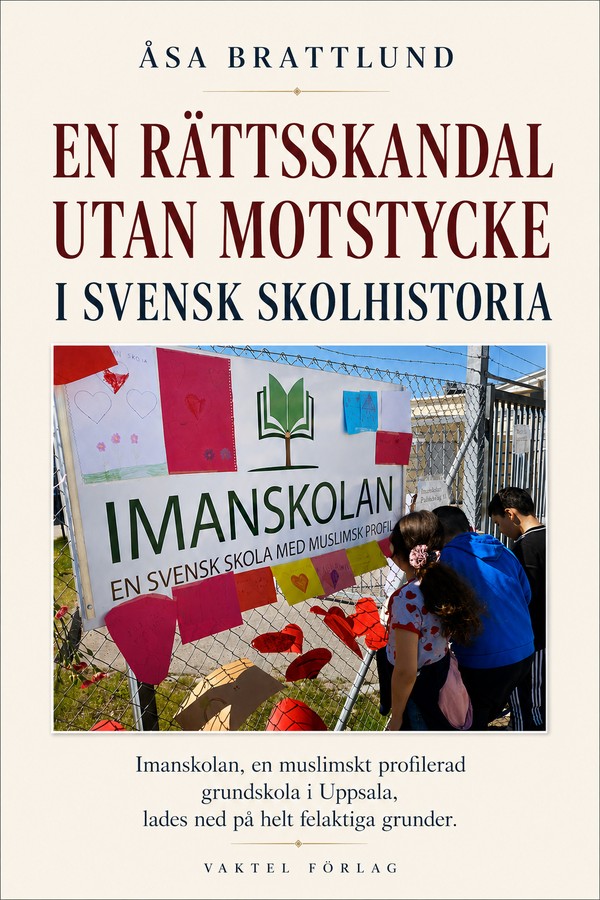
An Unprecedented Legal Scandal in Swedish School History:Imanskolan, a primary school with a Muslim profile in Uppsala, was closed down on entirely false grounds
By Åsa Brattlund
How can a school with more than 200 pupils be shut down without the authority even visiting the school?
After more than 25 years in operation, Imanskolan in Uppsala was forced to close. The Swedish Schools Inspectorate based its decision on a statement from the Swedish Security Service – yet no inspection of the school itself was ever carried out. Pupils, teachers, school management and parents were never given the opportunity to present their side before the decision was made.
In En rättsskandal utan motstycke i svensk skolhistoria (An Unprecedented Legal Scandal in Swedish School History), researcher and educator Åsa Brattlund examines the circumstances behind the closure. She has followed Imanskolan since 1998, and here she goes through official decisions, legal proceedings, interviews and other source material. Her examination leads her to a shocking conclusion: Imanskolan was closed down on false grounds.
At the same time, the book is about something bigger than a single school. It raises uncomfortable questions about legal certainty, the exercise of public authority, political campaigns and how schools with a Muslim profile are viewed in Sweden.
It is the story of a school that disappeared – and of the people who never felt they were given a chance to be heard.
Imanskolan in Uppsala was closed down on entirely false grounds.
A frightening account of a primary school that was subjected to a legal scandal without precedent in Swedish school history
All schools but one have been closed down. There is now only one school with a Muslim profile left in Sweden. Around 17 schools with a Muslim profile were closed down by the Schools Inspectorate over a five-year period (2019–2024). Around 8 of these schools were closed down with the support of the Swedish Security Service (Säpo). The book focuses on one of these schools, Imanskolan, a primary school (preschool class – year 6 and after-school care) in Uppsala that was founded in 1996 and that the Schools Inspectorate closed down in December 2022 with the support of a statement it had requested from Säpo.
The Schools Inspectorate carried out no announced or unannounced inspection, nor any review of the school environment and the values that prevailed at Imanskolan.
Säpo carried out no review at Imanskolan. No interviews or questioning were conducted with the named individuals who were accused of posing a risk of spreading Islamist values at the school. None of these named individuals were employed at Imanskolan.
Säpo withheld from Imanskolan, the Schools Inspectorate and the Administrative Court in Stockholm who the source or sources were for all the claims and accusations that Säpo directed at Imanskolan and the school’s management.
The Schools Inspectorate made the decision to close Imanskolan without knowing who the source(s) of Säpo’s accusations were.
The Administrative Court in Stockholm ruled without knowing who the source or sources were.
Säpo’s source: Only after the ruling of the Administrative Court was it revealed that Säpo’s source was not any person, but two books written by an author known to Imanskolan and other schools with a Muslim profile as a hard-line political opponent of such schools. Books that are not about Imanskolan, but about the author’s speculations on Islamist links between the Muslim Brotherhood and a person, UA (who did not work at Imanskolan), and Imanskolan and other schools with a Muslim profile. Säpo devotes most of its statement to pasting in descriptions of what UA is alleged to have said. Claims that were wholly or largely not produced by Säpo but copied from two books.
Neither Säpo nor the Schools Inspectorate questioned or interviewed UA. UA, who was singled out as the main reason for the Schools Inspectorate’s closure of Imanskolan. A school with around 215 pupils and 45 staff.
Most of the teachers and the pupil health staff had a non-Muslim background. The school management included a teacher, a lead teacher of non-Muslim background with an atheist outlook on life. Several members of staff had worked together for more than twenty years.
The Schools Inspectorate attached no weight to the fact that the Imanskolan Foundation and its legal counsel, in a submission to the Schools Inspectorate, pointed out point by point that the accusations were unfounded. Imanskolan’s objections were disregarded. The Schools Inspectorate’s conduct can be interpreted as meaning that it did not matter what the Imanskolan Foundation and its legal counsel put forward in their criticism of the claims that turned out to have been taken from two books. Written by an opponent of Imanskolan and other schools with a Muslim profile, an author who had never been to Imanskolan or, as far as I know, to any other school with a Muslim profile.
An accusatory discourse: The book shows that an accusatory discourse – describing schools with a Muslim profile as Muslim, Islamic or Islamist schools – has spread a false picture to the public that there are religious schools in Sweden. When in fact these are schools with a Muslim profile that, within the curriculum time set aside for the school’s own choice, devote 60 minutes a week to their profile subject.
A politicised mob: Ever since the first school with a Muslim profile opened in Sweden in 1993, Imanskolan and other schools with a Muslim profile have been heavily targeted by a politicised mob. During the school’s 26 years of operation, no politician visited Imanskolan to see everyday school life.
Quotes from the book:
Uppsala’s municipal politicians never visited Imanskolan during the school’s 25.5 years of operation. The politicians chose not to visit Imanskolan, meet pupils and staff and see everyday school life.
How hard could it have been, as a municipal politician, to get on a bike and cycle from the municipal offices in Uppsala to Imanskolan, ten minutes away?